One of the things I love about foodservice is how much of our industry is built on relationships. Manufacturers, distributors, and operators who have worked together for years want to preserve that trust. Trade programs are central to those partnerships.
Working with manufacturers across the industry, I see trade teams with access to more data and more sophisticated commercial systems than at any point in my career.
That progress brings a new challenge: information overload. With so much data at their fingertips, teams often begin the planning process by gathering and analyzing as much information as possible without a clear sense of what they’re looking for. They can easily spend considerable time exploring the data and still walk away without a decision. When I work with manufacturers, I encourage them to reverse that approach and start with two questions: What are we trying to decide, and what evidence would give us confidence in that decision?
Trade Decisions and the Evidence Behind Them
For a trade team, the decision might be whether to continue, adjust, expand, or discontinue a program. These are the same choices we explore in our 2027 Trade Governance Report when determining where the next dollar goes. Defining the decision up front helps focus the analysis. Consumer research, market data, CRM activity, and operator purchase data all have value, but not every decision requires all four.
Trade is an area where the consequences of poorly informed decisions are particularly tangible because there’s a payment attached. For many manufacturers, trade spend is the second-largest expense after cost of goods sold. With that much at stake, decisions about where to invest those dollars should be grounded in evidence from the operator location, where the purchase actually occurred.
Two Trade Claims on One Purchase
In foodservice, a single sale can involve the manufacturer, a redistributor, a distributor, and a GPO. When an operator buys your product, whose effort earned the sale?
Consider an independent restaurant that purchases 20 cases through its distributor. The distributor considers the restaurant a street customer, part of its own book of business, so those purchases are ineligible for a GPO incentive. Yet that same restaurant can also appear on a GPO member list, and the GPO submits a rebate claim for those 20 cases.
Same operator. Same 20 cases. Two conflicting views of which trade program should apply. The manufacturer is left to determine which incentive, if any, was earned.
Manufacturers often pay distributors earned income on street volume months in arrears to allow time for GPO rebate claims to arrive and the associated volume to be excluded. If GPO purchases are not accurately identified and removed from eligible street volume, the manufacturer can end up paying both the GPO rebate and distributor earned income on the same cases. That’s how a manufacturer can end up paying a double dip it never intended to pay.
Three Moments of Trade Governance
Double dips are painful for everyone involved. They take time to resolve and create friction in relationships that manufacturers, distributors, and operators have built over years. The goal is to avoid creating them in the first place.
That starts with a simple principle: a trade dollar should reward the commercial effort that influenced the sale, and reward it only once. Determining who earned that dollar becomes complicated when a single purchase can fall under multiple agreements.
So, I think about trade governance at three critical points in the life of a trade dollar:
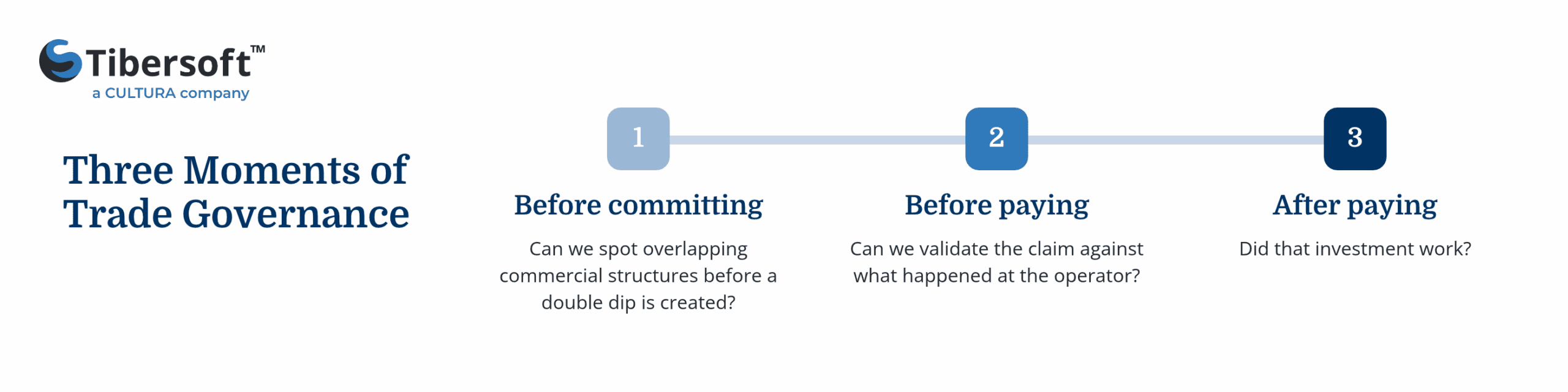
I consider the third moment, understanding trade spend ROI, the most consequential. Prevention and recovery protect margins, but understanding what I got for that investment helps me decide where to commit the next dollar.
Even if I don’t overpay a dollar, I can still make the wrong commercial decision if I misunderstand what drove the volume. I could invest more heavily in a program that appears successful but did nothing to change operator behavior and only eroded my margins.
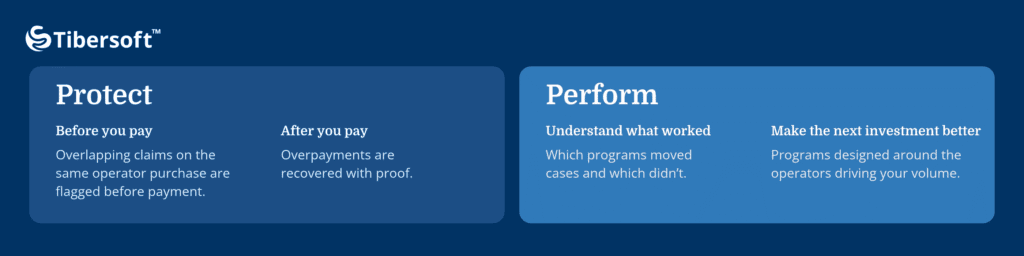
The Trade Governance Model: Protect and Perform
Protecting trade dollars and understanding what they deliver are the two pillars of the trade governance model outlined in our 2027 report, From Trade Leakage to Trade Governance.
Protect is about control: evaluating new proposed deals against active programs at the operator location before approval, then using findings from post-payment audits to strengthen preventive controls.
Perform is about direction: evaluating operator purchasing behaviors before, during, and after a trade investment to determine which programs to continue, adjust, expand, or discontinue.
Looking Ahead to 2027
IFMA The Food Away from Home Association expects total operator spending across food-away-from-home segments to grow 0.9% in real terms in 2027, or 4.2% including inflation. With minimal real industry growth, rising sales targets, and little to no growth in trade budgets, every trade dollar needs to work harder. Teams that start with the decision, apply governance throughout the life of a trade dollar, and use what they learn to inform future investments are better positioned to make each dollar count. If your team is planning 2027 programs, Part Three of our 2027 report, From Trade Leakage to Trade Governance, is a good place to start. The report lays out the full model with practical steps, and our five-minute Trade Maturity Assessment can show where your trade operation stands today. My colleagues Cassandra Hum and Judy Bennett also covered how trade operations mature in our IFMA member webinar. If you’d like to talk through which decision to start with, I’d welcome the conversation.Frequently Asked Questions
Where should a foodservice trade team start with trade governance?
How can manufacturers measure trade spend ROI in foodservice?
Manufacturers can evaluate operator purchasing behavior before, during, and after a trade investment. Did volume grow? Did new operators begin purchasing? Was the growth sustained after the program ended? Understanding which commercial activities contributed to those results, and whether the incremental profit justified the investment, helps manufacturers determine which programs to continue, adjust, expand, or discontinue.
Why can two trade claims apply to the same purchase?
An operator may be classified as a distributor’s street customer while also appearing on a GPO member list. If the GPO submits a rebate claim and the associated volume is not excluded from the distributor’s eligible street volume, the manufacturer may pay both a GPO rebate and distributor earned income on the same cases, resulting in a double dip.
How much trade spend can trade governance protect?
Based on decades of Tibersoft trade audit data, manufacturers can protect up to 5% of trade spend across segments through location-level claim auditing, with even greater savings in certain non-commercial segments. Actual exposure to trade leakage varies by manufacturer, depending on GPO participation, distributor relationships, trade program structures, and the segments they serve. Manufacturers that implement controls as part of their trade program approval process can save even more.